

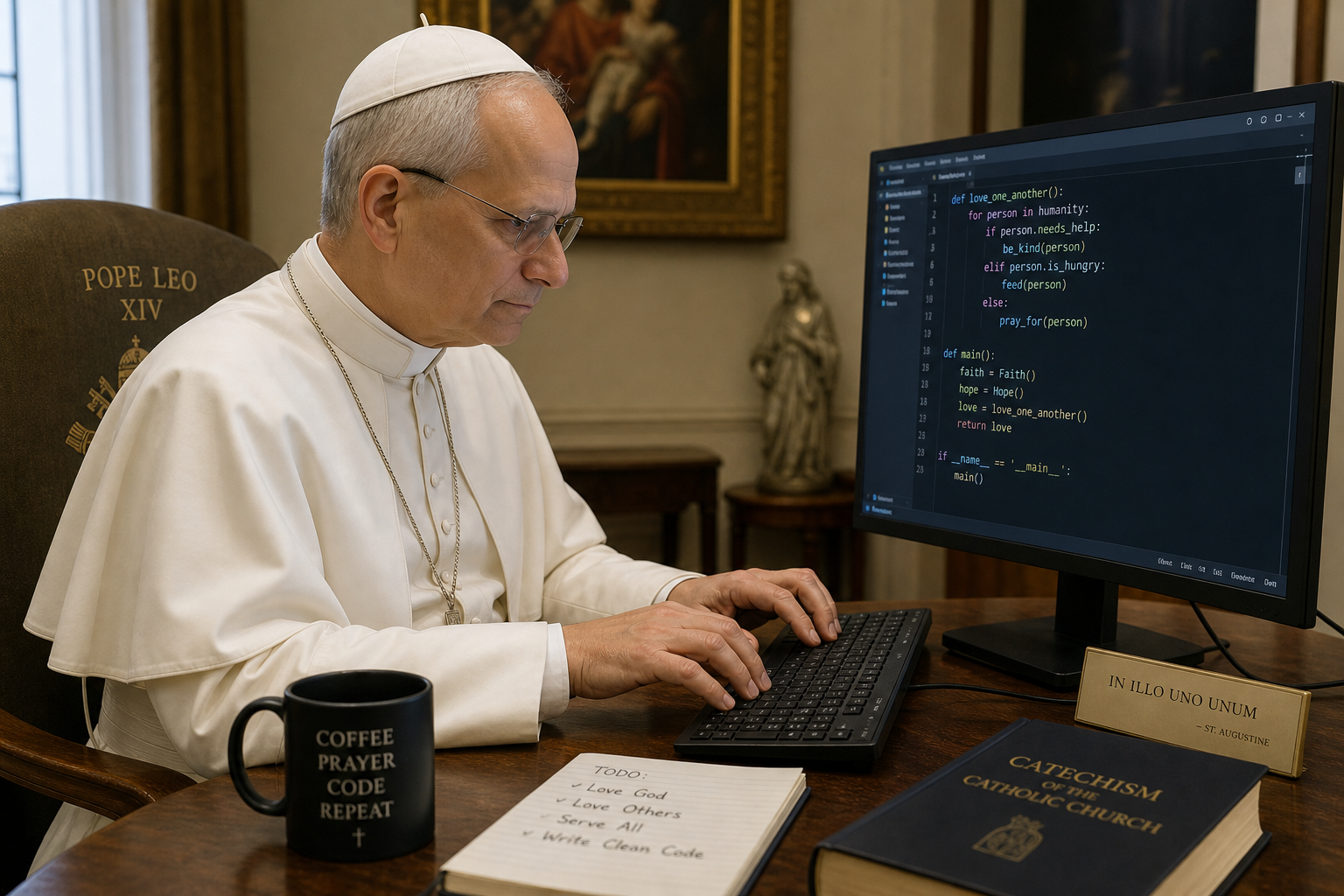
Pope Leo XIV will release his first encyclical on May 26th, focusing entirely on artificial intelligence and human dignity in the digital age. The document, titled “Magnifica Humanitas” (Magnificent Humanity), breaks Vatican protocol by featuring Anthropic co-founder Chris Olah as a lay speaker, an almost unprecedented move for papal encyclical releases. The timing is deliberate: signed exactly 135 years after Pope Leo XIII’s “Rerum Novarum,” which addressed industrial revolution labor rights, positioning this as the Catholic response to the AI revolution.
The Vatican-Anthropic partnership reveals a fascinating exchange of legitimacy. Olah leads interpretability research at Anthropic, trying to understand what happens inside AI black boxes, conveniently aligned with the Church’s concerns about trustworthy AI systems. Meanwhile, Anthropic faces friction with the US government over military AI applications, making the Vatican’s moral endorsement valuable for their “responsible AI” branding. The company has systematically courted religious authorities, involving clergy in Claude’s constitutional framework and participating in interfaith AI ethics discussions across multiple religious traditions.
Critics see this collaboration as elaborate theater. Dylan Baker from the Distributed AI Research Institute argues that “ethical AI” discussions obscure the fundamental question: should certain AI systems exist at all? When the framework becomes “let’s build it responsibly” instead of “should we build it,” the real debate gets sidestepped entirely. The Vatican’s moral authority covers 1.4 billion Catholics, more people than any AI regulation reaches, but papal encyclicals carry no legal weight, just aspirational guidelines that tech companies can ignore whenever convenient.
The deeper philosophical question lurking beneath all AI ethics discussions remains: what makes humans irreplaceable when machines increasingly mimic human capabilities? Traditional answers, intelligence, creativity, language, emotional reasoning, are being systematically demolished by AI progress. Perhaps human uniqueness lies in our fundamental limitation: mortality. We make moral choices knowing we’ll face consequences, carry regret, and lose irreplaceable things. AI can simulate ethical reasoning, but it cannot experience the existential weight of finite existence that gives human decisions their moral gravity. The real danger isn’t AI making bad choices, it’s humans voluntarily outsourcing moral responsibility to systems that can never truly understand what’s at stake.
